

A slow-travel year sounds wonderfully simple: choose a beautiful place, rent an apartment, work a few focused hours, and spend the rest of the day exploring coastlines, mountain towns, and neighborhood cafés.
The paperwork is less romantic.
If you plan to earn while abroad, the choice between a digital nomad visa and a tourist visa affects how long you can stay, whether your work is authorized, what taxes you may owe, and whether your healthcare coverage will hold up when you need it. The right answer depends less on the destination’s Instagram appeal and more on your income, work arrangement, family, and tolerance for administrative uncertainty.
Here’s how to choose.
The short version
| Digital nomad visa | Tourist visa or visa-free entry | |
|---|---|---|
| Best for | A long-term base in one country | Short stays and multi-country travel |
| Typical duration | Six to 24 months, depending on the program | Often 30–90 days; some countries allow longer |
| Remote work | Usually expressly permitted for foreign employers or clients | Often prohibited, unclear, or legally limited |
| Income requirement | Commonly around $2,000–$5,000 per month | Usually no income threshold, but proof of funds may be required |
| Renewal | Often possible, but not guaranteed | Extensions may be limited; repeated entries can attract scrutiny |
| Tax clarity | Better immigration clarity, but not automatically tax-free | Tourist status does not prevent tax residency |
| Paperwork | Higher: contracts, bank statements, insurance, background checks | Lower at first, but more day-counting and border planning |
The key distinction: a visa that lets you enter a country is not necessarily permission to work there.

How a digital nomad visa works
Digital nomad programs are designed for people who work remotely for companies or clients outside the host country. Depending on the destination, you may receive a long-stay visa, temporary residence permit, or a special remote-worker status.
Applications commonly ask for:
- Proof of foreign employment or freelance contracts
- Recent bank statements and payslips
- Minimum monthly or annual income
- Health insurance covering the full stay
- Police clearance or background checks
- Proof of accommodation
- Passport photos, translations, and sometimes apostilles
Income requirements vary dramatically. Many programs cluster between $2,000 and $5,000 per month, but popular European options can be higher.
For example, Portugal’s D8 route is tied to four times the national minimum wage. Based on the 2026 figure cited in Portugal’s official means-of-subsistence guidance, a single applicant should plan around €3,680 per month, usually demonstrated over the previous three months. Start with the official Portuguese visa guidance, then confirm the checklist used by the consulate handling your application.
Italy’s digital nomad framework has generally been associated with income of roughly €28,000 gross per year, although the underlying benchmark can change. Treat that figure as a planning estimate, not a guarantee, and verify the 2026 requirement directly with the relevant Italian consulate.
Albania is a useful example of why online visa guides can be confusing. Its route is generally structured as a unique permit for digital or mobile workers, rather than a simple “digital nomad visa.” The law refers to sufficient means rather than one universal euro figure, while practical guidance cites thresholds in Albanian lek and different proof-of-funds routes. Confirm the current requirement with the Ministry of Interior or the office processing your application before relying on a low headline number.
A digital nomad visa may be valid for one year, renewable for another year, or attached to a longer residence pathway. Read the fine print carefully: some programs require you to spend a minimum number of days in the country, while others do not lead toward permanent residence.
What happens if you use a tourist visa?
Tourist status is attractive because it is fast, familiar, and often inexpensive. For a two-week trip or a month-long test run, it may be exactly what you need.
The trouble begins when “a month” quietly becomes nine months.
Tourist permission is intended for tourism, visiting friends, and other non-work activities. Some countries tolerate remote work for foreign employers in practice, while others interpret working from a laptop as work carried out on their territory. The rules are not consistent, and border officials may not share the assumptions found in a nomad forum.
A tourist stay may also require:
- Proof of onward travel
- Evidence of accommodation
- Proof of funds
- Travel medical insurance
- Strict limits on cumulative days
In the Schengen Area, the familiar rule is 90 days in any rolling 180-day period. Leaving for a weekend does not reset the clock. In other countries, the permitted stay may be 30, 60, 90, or even 365 days, but long admission does not automatically equal work authorization or tax exemption.
Visa runs are not a strategy
A visa run means leaving a country briefly and returning to restart or extend a tourist stay. Sometimes this is legal and routine. It is never something to assume.
Immigration authorities increasingly look at the pattern, not just the individual entry:
- Repeated exits after exactly 60 or 90 days
- A year spent living in one country on successive tourist entries
- Local rental agreements and personal belongings
- Evidence that you are working there
- No convincing onward travel plan
Possible consequences include a shortened stay, refusal of entry, fines, removal, or future visa problems. Even if you are admitted, an immigration officer may decide that you are effectively residing and working without the correct status.
If you want one country to be your home base for six months or more, a proper residence or digital nomad route is usually the more comfortable choice.
Tax: the visa label is only part of the story
A digital nomad visa does not automatically make your foreign income tax-free. A tourist visa does not automatically keep you outside the tax system.
Tax authorities may consider:
- Days physically present
- Your permanent home
- Where your family lives
- Your “center of vital interests”
- Where your business is managed
- Double-tax treaties
- Whether you have become tax-resident elsewhere
The commonly cited threshold is 183 days, but the exact test varies. You can also create tax complications before reaching 183 days, particularly if you establish a home, manage a business locally, or perform services for local clients.
Remote employees should ask their employer about payroll, social-security exposure, data rules, and permanent-establishment risk. Freelancers need to consider whether registering locally is required, whether local VAT applies, and how invoices will be treated.
Keep a travel-day spreadsheet, save entry and exit records, and speak with a cross-border tax professional before committing to a full year.
Healthcare and insurance
Most digital nomad visa applications require health insurance for the entire approved period. That requirement can be useful: it forces you to arrange proper coverage before arrival.
Tourists often rely on annual travel insurance, but check the exclusions. Many policies do not cover:
- Routine healthcare
- Pre-existing conditions
- Long-term stays beyond the original trip
- Motorcycle or adventure sports
- Work-related incidents
- Treatment after an undeclared change of residence
Neither visa type guarantees access to a country’s public healthcare system. For a slow-travel year, look for a policy that covers outpatient care, hospitalization, evacuation, and your planned activities. If you are traveling with children or managing a chronic condition, make healthcare availability part of the destination decision, not an afterthought.
A practical decision framework
Choose a digital nomad visa if:
- You want one main base for six to 12 months
- You have stable, documentable foreign income
- Your employer or clients approve the arrangement
- You want clearer permission to work remotely
- You are traveling with a partner or children
- You want to reduce border-crossing stress
- You are prepared to plan your tax residency
Choose tourist entries if:
- You are staying only a few weeks or months per country
- You are between contracts or not working during the trip
- You do not meet the income threshold for a nomad program
- You are comfortable moving regularly
- You will carefully track every day and entry condition
For freelancers
Look beyond the phrase “digital nomad visa.” Some programs accept freelance contracts with foreign clients; others are designed mainly for employees. A local self-employment or entrepreneur permit may be more suitable if you invoice several clients, hire locally, or want to establish a formal business.
For remote employees
Get written approval from your employer before booking flights. A visa may authorize your stay, but it does not solve payroll, insurance, confidentiality, or employment-law questions by itself.
For families
Check dependent rules, school access, proof-of-funds increases, and whether every family member must hold insurance. Portugal, for example, applies additional means-of-subsistence calculations for spouses and children. A program that works beautifully for one person may become expensive for a family of four.
Under-the-radar places worth considering
The obvious hubs are not always the best places for a slow year. We prefer destinations where your budget stretches further and daily life still feels local.
Albania’s coast
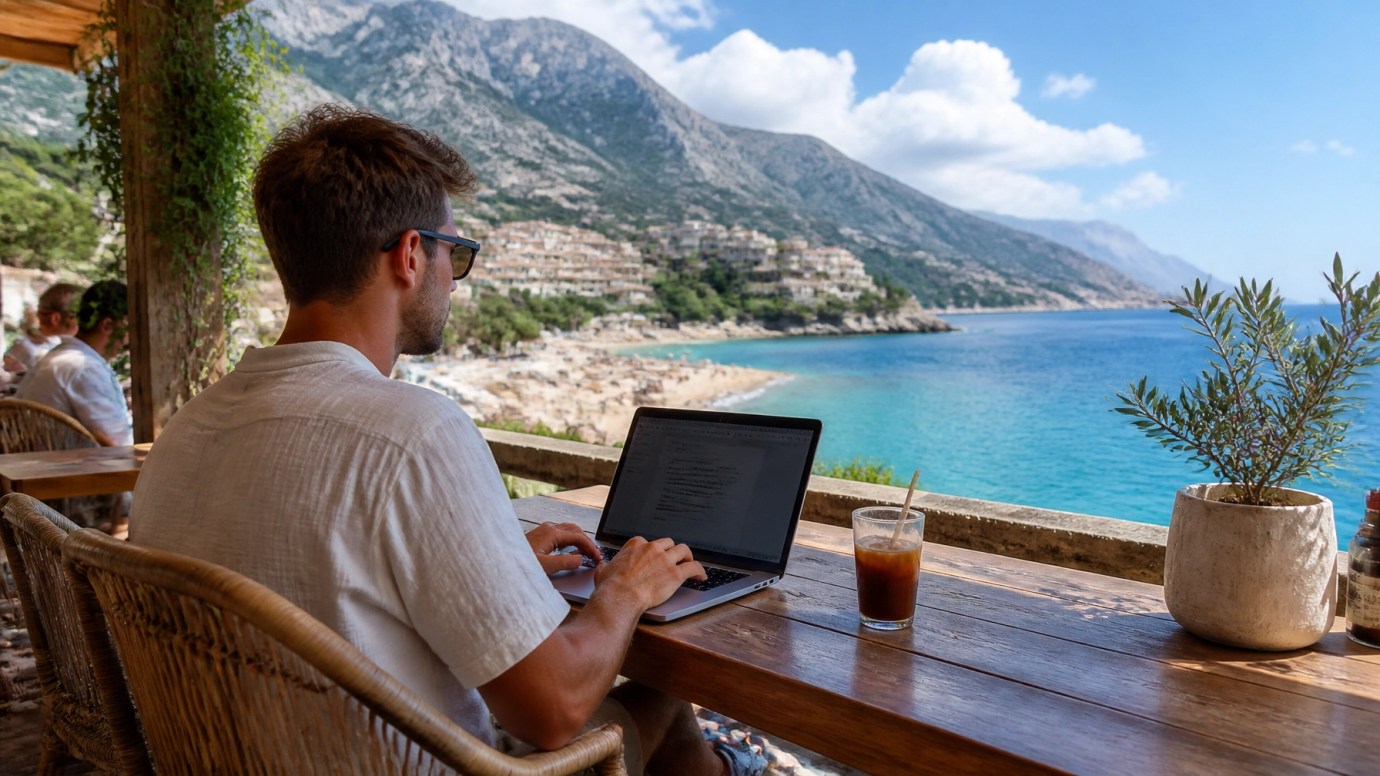
Vlorë, Himarë, and Sarandë offer a strong mix of sea air, affordable apartments, fast-growing connectivity, and access to the wider Balkans. Vlorë works well as a practical city base, Himarë is ideal for a quieter rhythm, and Sarandë offers more services and social energy.
Our digital nomad guide to Albania’s coastal towns covers the differences in rent, seasonality, internet, and lifestyle. Just remember that an attractive cost of living does not replace checking the current permit rules.
Georgia
Georgia has long appealed to slow travelers because eligible nationalities can receive up to 365 days of visa-free entry. That is not the same as a digital nomad residence visa, and 2026 labour-migration changes mean remote workers should investigate whether a labour-activity or work residence permit is required.
Spending 183 days or more in a calendar year can also create Georgian tax residency. Read current guidance carefully rather than relying on older “work from Georgia with no paperwork” posts. For visual inspiration, browse our Georgia place entry.
The wider Balkans
Sarajevo, Novi Sad, Ohrid, Plovdiv, and smaller towns in Montenegro or North Macedonia can make excellent slow-travel stops. But the Balkans are not one immigration zone: each country has its own stay limits, extensions, and work rules. Croatia is inside Schengen; Serbia, Montenegro, Bosnia and Herzegovina, Albania, and North Macedonia have different arrangements.
Use city-by-city planning rather than assuming a border crossing resets everything. Our Bulgaria place entry, Split guide, and Dubrovnik entry are useful starting points for building a regional route.
Lesser-known Portugal
Portugal’s D8 threshold is high, but the country becomes more interesting once you look beyond Lisbon. Consider Coimbra, Viseu, inland Alentejo, or the Algarve outside July and August. The trade-off is simple: fewer international coworking spaces, but more room to build a daily routine.
Compare the official requirements with real-world destination notes in our Algarve community place entry.

Lesser-known Italy
Italy’s digital nomad route can suit highly qualified remote workers, but the paperwork deserves careful preparation. Instead of defaulting to Rome, Milan, or Florence, investigate Perugia, Abruzzo, Le Marche, Puglia, or smaller Tuscan towns with strong rail connections and a slower winter rhythm.
Our Perugia place entry and Sorano, Tuscany guide offer a glimpse of the kind of places worth adding to your shortlist.

The bottom line
For a true slow-travel year, a digital nomad visa or residence permit usually wins on stability, legal clarity, and peace of mind, provided you meet the income and documentation requirements.
Tourist status remains useful for testing a destination, taking a work-free sabbatical, or stitching together shorter stays. It becomes risky when it is used as a substitute for residency, especially through repeated visa runs.
Choose your destination for the life you want to live, then choose the immigration route that supports it. Before departure, verify the current rules with the relevant consulate or immigration authority, map your tax days, arrange serious health coverage, and use local traveler experiences to pressure-test the plan. That is how you turn a year of movement into an adventure instead of an administrative emergency.